
The Heart of the Issue
Top 10 Best Video Game Magazines of All Time!
It might seem like a foreign concept in the digital age, but magazines used to be a big part of video game culture. Whether you wanted news about upcoming titles or additional information about the games you already owned, gaming magazines were an invaluable resource. Millions of gaming magazines were sold each month, and they had a huge impact on the industry at large. Great reviews could have a meaningful impact on sales, for instance, and a well-time cover story could be every bit as effective as any advertising campaign. Different magazines had different mission statements, but it was common for most publications to feature breaking news, helpful strategies, and in-depth interviews. The most successful magazines generally had their own voice, and they offered readers something different each month. The magazines on this list all left their mark in one way or another. Some of them survived for decades while others were merely a blip on the radar. In either regard, they make me long for a time when information was carefully curated. Online gaming content often feels like its disposable, whereas gaming magazines felt like a labor of love. Print media has been on the ropes for a long time, but I can’t tell you how exciting it was when a new issue of my favorite magazine hit the newsstands. I’d look forward to video game magazines almost as much as the games themselves!
10
PC Gamer
1993 – Ongoing
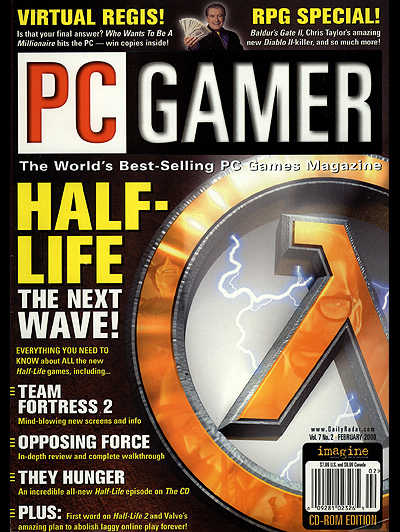
In the interest of full disclosure, I have never been an avid reader of PC Gamer. Nevertheless, the publication deserves recognition for being the longest running (and best selling) PC gaming magazine of all time. It has been published monthly in the UK since 1993, and the American version is almost as old. (Although the regional versions have distinct editorial styles, I’m including them as a collective entity on this list as a means of keeping the peace.) Some will argue that the magazine’s continued survival is largely based on name value, but you have to give credit where credit is due. I have been told that the publication has been trash for years, and I have occasionally come across an article that seems unnecessarily divisive. Any entity that has been around for as long as PC Gamer has is bound to have had its ups and downs. There are more mediocre episodes of the The Simpsons than there are good episodes, but that doesn’t take away from how amazing its first eight or nine seasons were. In a similar vein, it’s not entirely unfair for this list to emphasize the best years of PC Gamer. In its heyday, the magazine was seen as a credible source for news and reviews, and it provided ample information about hardware and software alike. Truth be told, the main reason why PC Gamer is being mentioned on this list is because the magazine shipped with demo discs. In an era before online demos were a viable option, this value-added bonus was the main selling point of PC Gamer. There weren’t many places where you could rent PC games, so demo discs were often the best way for PC gamers to play a game before purchasing it.
9
Electronic Games
1981 – 1985
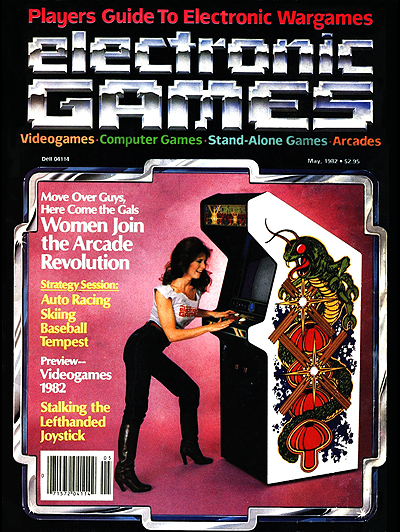
Electronic Games has the distinction of being the first dedicated video game magazine published in the United States. Although the publication was revived during the 16-bit era, this entry is mostly focused on its first run, which ran from 1981 through 1985. The industry was going through a lot of changes during this time, and new consoles were being introduced seemingly every other month. The Internet didn’t exist in a meaningful capacity, and many gaming companies didn’t have effective advertising departments or distribution lines. This made a publication like Electronic Games a necessity. In an era where consumers were being overwhelmed by choice, Electronic Games helped readers cut through the noise. In this sense, it was arguably the most important publication on this list. The magazine cast a fairly wide net, and they had comprehensive coverage of console, arcade, and home computer games. I love looking through old issues of Electronic Games and seeing what people thought about lesser-known platforms like the Astrocade or the Vectrix. They covered everything. I didn’t grow up reading Electronic Games and I have no nostalgia for the publication. Nevertheless, I feel like I’m opening up a time capsule every time I read the magazine. I think it’s important to give credit to the trailblazers, and Electronic Games helped pave the way for every magazine that followed.
8
Official U.S. PlayStation Magazine
1997 – 2007
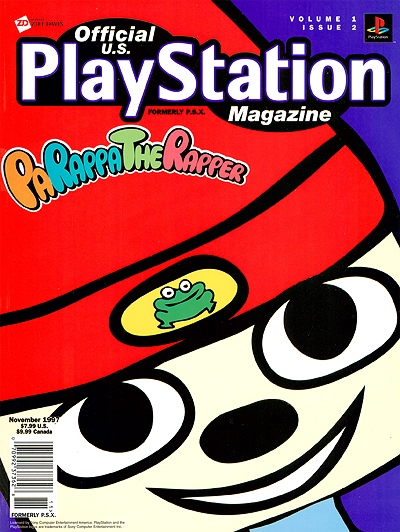
As its name implies, Official U.S. PlayStation Magazine was exclusively focused on PlayStation products. The publication was backed by Sony themselves, so it was a reliable source for news during its entire print run. Right out of the gate, the editors made it clear that they wouldn’t show any bias for (or against) any particular games just because they had Sony’s official backing. To their credit, the magazine felt like a celebration of the PlayStation brand rather than a glorified advertisement. The decision to feature a niche property like Ghost in the Shell on the cover of their debut issue instead of one of the PlayStation’s main franchises speaks volumes about the publication. Although I enjoyed reading OPM, the main reason why its being mentioned on this list is because it included a “free” demo disc with each issue. These discs inflated the price of the magazine somewhat, but it was still a tremendous value. The discs featured a healthy mix of killer apps and quirky titles that might otherwise go overlooked. As the first magazine to include demos of PlayStation titles, OPM offered readers something that its contemporaries couldn’t. In later issues, the discs would also include interviews, video walkthroughs, and coverage of industry events. These resources were amazing in a pre-YouTube world, and I still have my demo discs kicking around somewhere. When OPM began its run, we were in the midst of the PS1 era. By the time the last issue was published, the PS3 was on store shelves. All things considered, that’s not a bad run.
7
Retro Gamer
2004 – Ongoing
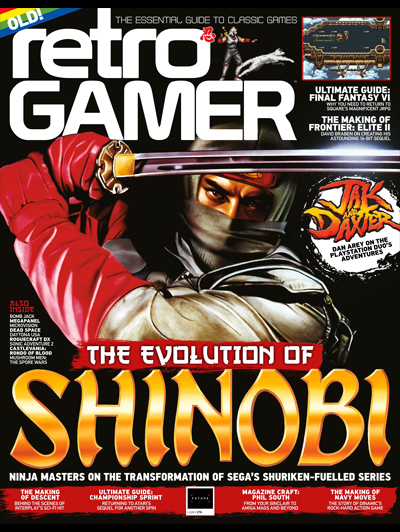
Video game magazines aren’t nearly as relevant as they were in decades past, so this list is naturally going to be fueled by nostalgia. With that in mind, Retro Gamer is a perfect fit for this countdown. (Nostalgia is the publication’s most important component, after all!). While most gaming magazines are hyper-fixated on the future, Retro Gamer is obviously more interested in the past. There are many reasons why this premise works so well. Since the editors have the benefit of hindsight, they’re less likely to waste ink on over-hyped releases that fail to deliver. In other words, the games that they cover generally deserve to be covered. They’re surprisingly comprehensive, too, and the magazine look at everything from the Atari 2600 to the PlayStation 2. Their buyer’s guides are helpful, their interviews are fascinating, and their editorials are insightful. (I also enjoy their lists, but that probably goes without saying.) I’ve been interested in gaming for as long as I can remember, and I still learn something new in every issue. I’m also consistently impressed by the magazine’s production values, and I love how seamlessly they incorporate screenshots into their layouts. The editors are clearly passionate about what they do, and you can tell that they put a lot of effort into each issue. If there’s one magazine on this list that matches the spirit of this website, it’s definitely Retro Gamer.
6
PSM
1997 – 2007
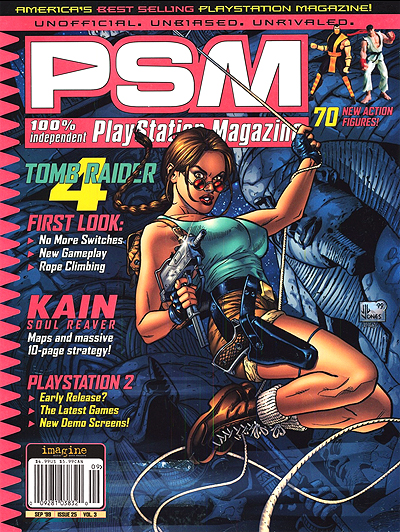
PSM (or PlayStation Magazine) was completely independent, and it felt decidedly less corporate than Sony’s “official” magazine. They covered the same games that everyone else did, but their publication had a unique tone that was laced with irreverent humor. It was basically gaming’s equivalent to ToyFare, and even their image captions were entertaining. They did things a little bit differently than the other guys, and they’d often include fun bonuses like memory card stickers. PSM prided itself on being 100% independent, but they were rebranded as PlayStation: The Official Magazine after OPM went tits up in 2007. Speaking of tits, younger generations cannot possibly comprehend how horny magazines were in the early 2000s. Discounting the adult magazines that typically occupied the top shelf, men’s lifestyle magazines like Maxim and FHM typically featured scantily-clad pictures of A-list actresses, and women’s magazines like Cosmopolitain were every bit as sordid. During this era, the gaming industry was becoming increasingly more focused on mature audiences. This paradigm shift was felt in the gaming press as well, and this is readily apparent with PSM. While the publication was ostensibly focused on PlayStation products, the editors were clearly more interested in something else entirely. Games like Dead or Alive and Rumble Roses were routinely given cover stories, and Lara Croft graced the cover of the magazine on nine separate occasions during the publication’s ten-year run! They went out of their way to highlight gaming babes at every turn, and readers could look forward to annual swimsuit issues each year. It might seem like I’m hyper focused on one aspect of the magazine, but PSM is one example where you can judge a book by its cover. PSM was clearly a product of its time, but it was a better time.
5
Famitsu
1986 – Ongoing

First published in 1986, Famitsu is the most important gaming publication of all time. Although I’ve owned issues of the Japanese magazine, I am unfortunately unable to read moon runes. This obviously means that I can’t comment about the quality of the writing or the overall tone of the magazine. (Countless Famitsu articles have been translated over the years, however, so it’s not as though I’m completely unaware of their editorial style. I feel like I’ve read at least one Famitsu article each month for the past two decades!) The magazine’s influence is impossible to ignore, and its four-person review crew served as the inspiration for American publications like Electronic Gaming Monthly. The Internet has made print media largely irrelevant in recent decades, but the editors at Famitsu apparently didn’t get the memo. Each issue still sells hundreds of thousands of copies, and the magazine remains a reliable source of breaking news and exclusive content. Gaming websites frequently write articles about the latest Famitsu reviews, interviews, and sales charts, and it’s almost certainly the world’s most talked about gaming magazine. It’s a publication that I literally can’t read, but I feel compelled to put it on this list due to its historical significance and its lasting impact on the industry. Put simply, leaving Famitsu off of this list would be like leaving George Washington off of Mount Rushmore.
4
Edge
1993 – Ongoing

Edge launched in October of 1993 and new issues are still being printed each month. Outside of Famitsu, no publication on this list has had a longer run. The UK-based magazine has always emphasized the process of making games as much as the final products themselves. A typical issue features in-depth developer interviews, as well as articles educating readers about some of the more technical aspects of game design. Like most magazines on this list, Edge has ample information about upcoming games. They’re also willing to look at things through a historical lens, however, and their retrospective articles are written with the benefit of hindsight. In general, the editors at Edge are less likely to be blinded by hype than most gaming critics. They tend to be a lot more conservative with their scores, so it getting a perfect ten from their publications still carries weight after all these years. Although Edge isn’t a magazine I grew up with, I read many articles from the magazine without even realizing it. (Incidentally, some of the content from Edge was re-published in the pages of Next Generation, which was more readily available where I grew up.) Edge isn’t necessarily as fun as some of the other magazines on this list, but I appreciate how informative and insightful they are. There’s a reason why they have survived for as long as they have, and they have outlived almost every other publication on this countdown.
3
Nintendo Power
1988 – 2012
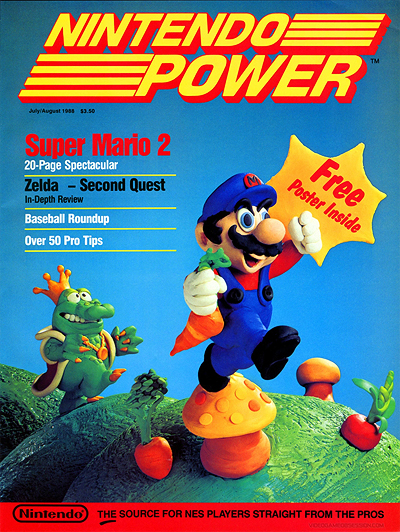
More so than any other magazine on this list, Nintendo Power was an institution. For years, every licensed game for every Nintendo platform included an insert that promoted the magazine. Nintendo Power was largely focused on upcoming games, but it was also an invaluable source for all the latest tips and tricks. They’d frequently publish detailed maps with helpful strategies, and this was especially useful in an era before in-game maps were a viable option. There were a lot of things about Nintendo Power that made it stand out. I have fond memories of the tri-fold posters that were included in each issue, for example, and I enjoyed reading the various comic strips each month. The magazine was clearly aimed at a younger demographic, and the editors obviously knew how to speak to their audience. One of the best things about Nintendo Power was the subscription bonuses. In various years, readers were sent special bonus issues, promotional VHS tapes, and exclusive posters. Without question, the best bonus of all was a copy of Dragon Warrior. This helped promote the franchise in the West, and it also helped popularize the RPG genre as a whole. Another unique aspect about Nintendo Power was the fact that it was ad-free for nearly a decade. Unfortunately, the magazine itself felt like an advertisement onto itself. The editors would seldom take a critical stance against anything, so you had to take everything they said with a grain of salt. They weren’t exactly an unbiased source of information, but Nintendo Power left a lasting impression on its readers and gaming culture in general. Did I mention that they gave away Dragon Warrior for free?
2
Diehard GameFan
1992 – 2000
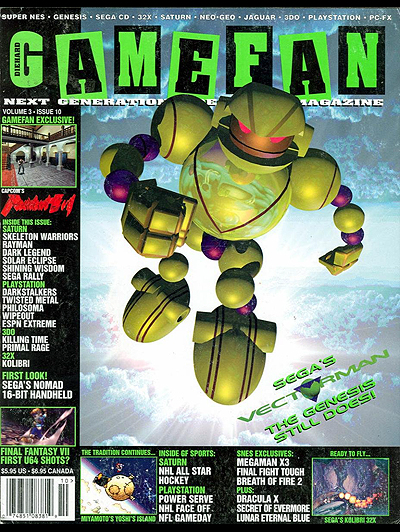
I’ll never forget the first time I picked up an issue of Diehard GameFan. I had ventured into my local bookstore hoping to find the latest issue of EGM. I couldn’t find what I was looking for, so I ended up buying a copy of GameFan instead. The magazine was only about half as thick as a typical issue of EGM, but it felt like a luxury product. The paper had a premium feel to it, and the print quality was unmatched. In an era where many video game screenshots still looked like they were taken with Polaroid cameras in less-than-ideal lighting conditions, GameFan used capture cards to produce the clearest possible images. They published a lot of images, too, and their vibrant layouts made use of every square inch of every page. A typical issue of GameFan would have more images than magazines that were twice as large. If there’s one slight against the magazine, it’s that their review crew was overly generous. Their scores were ridiculously high, and games that were universally panned elsewhere were saddled with praise in the pages of GameFan. (As an example, they gave Cybermorph on the Jaguar reviews of 99, 96, 98, and 98! Even Bubsy 3D earned 80, 79, and 80!) When I was a kid, I thought every game was awesome regardless of how bad it was. That’s the kind of enthusiasm GameFan had. I truly believe that they enjoyed (almost) every game they ever played. Although this list is obviously focused on video games, I also appreciated how tuned in GameFan was to Japanese pop culture. Their editors would often write about anime, and their enthusiasm opened up my eyes to a whole new world.
1
Electronic Gaming Monthly
1988 – 2014
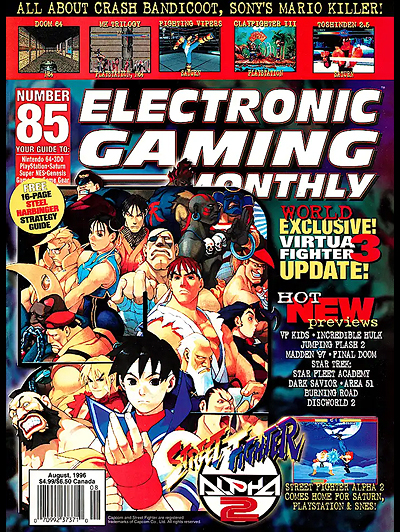
Electronic Gaming Monthly is easily the greatest video game publication of all time. The magazine had a bit of everything. A typical issue would have exclusive stories, breaking news from Japan, and plenty of cheat codes. It felt like we were getting a comprehensive look at the entire gaming industry each an every month, and I was taken aback by how much information was packed into every issue. (Senior editor, Ed Semrad was an avid photography enthusiast, and he devised a contraption that could be placed over monitors and television screens in order to block out external light. This allowed him to capture images at trade shows that publishers didn’t necessarily want the general public to see!) The magazine exceeded 400 pages on numerous occasions, and some of the holiday issues were more akin to encyclopedias. Without question, my favorite part of the magazine was its review crew. A lot of magazines would assign one editor to each game, and you were ultimately left with one person’s opinion. EGM adopted the Famitsu model and had multiple people review each release. During the magazine’s prime years, the same core group would (somehow) review each and every game. Although review crew members would come and go, it wasn’t unusual for them to stick around for years at a time. This ultimately added an extra layer of context to each review, since we understood the sensibilities of the individual reviewers. As an example, Dan Hsu was an outspoken critic of first-person shooters and would typically review them several points lower than his fellow editors. Fans of the genre could disregard Dan’s reviews if they so desired, because they understood his specific tastes. At the same time, when he gave GoldenEye a 9.5 in 1997, it was a clear indication that the game was a different kind of first-person shooter. Although I had my favorite sections, I would read every issue cover to cover, and I found value on every page. EGM had enough content each month to warrant the release a second monthly magazine, appropriately known as EGM2.




Do you agree with this list? Let us know what you think by leaving a comment below. Your opinion matters!