
Ctrl + C, Ctrl + V
Top 10 Best Palette-Swapped Video Game Characters of All Time!
Palette swaps were a practical necessity in early game design, and strict memory limitations made it more efficient to recolor existing sprites than to draw entirely new ones. Relying on palette swaps allowed developers to populate screens with hordes of enemies, expand playable rosters, or support simultaneous multiplayer without ballooning the game’s size. The characters on this list stand out for different reasons. Some gradually acquired distinct personalities and visual identities, for example, while others helped build the foundation for co-op gameplay as we know it. Although palette swaps are not as necessary today as they were in decades past, developers are still finding creative ways to color outside the lines.
Examples: Ninja Turtles, Powerpuff Girls, Care Bears
10
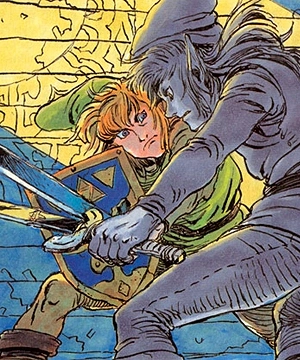
Dark Link
Zelda II: The Adventure of Link
The purest expression of the “evil twin” palette swap, Dark Link first appeared as the final boss of Zelda II: The Adventure of Link. He was presented as a manifestation of Link’s inner darkness, and he had the same weapons, movements, and silhouette. He was a fitting Last Boss, and Link essentially had to defeat himself in order to obtain the Triforce of Courage. The willingness to face the worst version of yourself is the very essence of courage, and this makes Dark Link seem like a poetic metaphor rather than a technical shortcut. Versions of Dark Link have shown up in subsequent Zelda games, and he serves as a recurring reminder that the hardest enemy a hero will ever face is the one who knows them best. It would be easy to pass him off as a mere palette swap, but Dark Link turned a simple visual inversion into a lasting thematic statement.
9
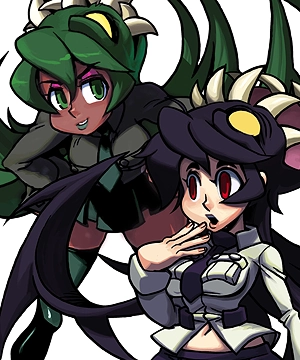
Fukua
Skullgirls Encore
Most palette swapped characters are born of necessity, but Fukua arrived long after the era of memory constraints. She was conceived as an April Fool’s joke and a deliberate parody of Decapre from Ultra Street Fighter IV. Fukua is nearly identical to Filia, right down to the parasites living in their hair. She’s most differentiated by a sickly green palette and an unhinged attitude. Her fighting style is cobbled together from unused Filia concepts, and her voice lines are recycled too. Her story mode consists of a single-minded quest to replace Filia. An intentional clone who exists to mock the idea of intentional clones, Fukua is both a parody of and a tribute to the palette swap tradition. To drive the point further, she has dozens of alternative colors that are thinly-veiled references to palette swapped characters from other games.
8
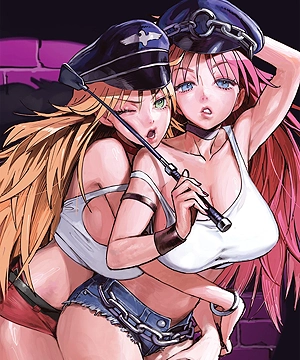
Poison & Roxy
Final Fight
Roxy and Poison are differentiated almost entirely by hair color. (Poison’s known for her pink mane while Roxy’s hair is bright orange.) The girls walk the same Metro City streets, they serve the same Mad Gear gang, and they wear the same skanky outfits. They also made their debut in the same game, and they fought shoulder to shoulder with each other. The girls were at the center of a long-running gender controversy that should have been attached to both characters equally, but Poison is the only one who benefitted from the increased exposure. Poison became a franchise mainstay and is now a part of the Street Fighter roster. Roxy is little more than a footnote, and her contributions seldom extend beyond an occasional background cameo. In terms of fame and porn notoriety, few palette-swapped pairs have diverged so sharply.
7
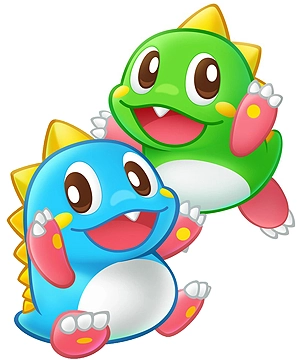
Bubblun & Bobblun
Bubble Bobble
Drop-in multiplayer was an important feature in the 1980s arcade scene. For obvious reasons, arcade owners loved giving additional players a reason to pump more coins into the machine mid-game. Bubble Bobble had over 100 levels that got progressively more difficult, so cooperation was strongly encouraged. Some levels were virtually impossible by yourself, and you couldn’t even see the true ending unless you were playing alongside a palette-swapped friend. (Most home versions removed the drop-in component, but they still rewarded teamwork.) Even though Bubblun and Bobblun are virtually identical, the game is significantly more enjoyable when they’re working together. The adorable green-and-blue dinosaurs can blow bubbles to imprison their enemies, but the power of friendship is their most important commodity.
6
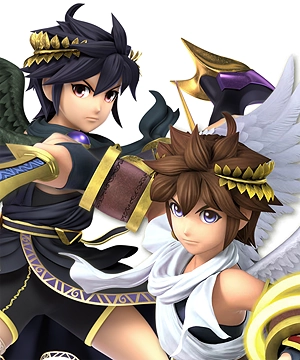
Dark Pit
Kid Icarus Uprising
Dark Pit is an antagonistic rival who possesses all of Pit’s divine abilities. With his dark hair, black clothing, and shadowed wings, he paints himself as the embodiment of Pit’s inner wickedness. Although he reluctantly accepts that he’s not truly malevolent, he bristles at the suggestion that he’s a mere duplicate. Like Fukua, Dark Pit is a self-aware critique of the palette swap trope. He knows he’s a clone born from the Mirror of Truth, but his true origins date back further than he realizes. In Super Smash Bros. Brawl, Pit had an alternate outfit with an inverted color scheme that became the basis for Dark Pit’s Uprising design. Dark Pit resents the fact that he’s a duplicate, but he wouldn’t even exist if Pit didn’t happen to have a dark color variant. Bringing things full circle, Dark Pit had an alternate light color scheme when he eventually joined the Smash roster.
5
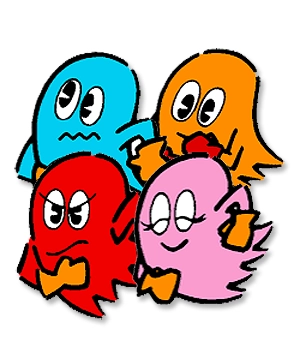
Inky, Blinky, Pinky, and Clyde
Pac-Man
The Pac-Man ghosts are among the earliest examples of palette-swapped characters who refuse to behave as mere re-colors. Although they shared the same sprite, Namco gave them distinct names, personalities, and AI routines. Blinky relentlessly hunts Pac-Man’s current position, Pinky attempts to cut him off, Inky calculates complex flanking maneuvers, and Clyde alternates between pursuit and retreating sub-routines. Casual players will treat them as interchangeable threats without realizing that the colors are reliable visual cues for how each ghost will behave. Palette-swapped enemies became a defining staple of 1980s game design, but Pac-Man proved that identical shapes could hide distinct personalities and strategies. Clyde was later replaced by Sue in Ms. Pac-Man, which serves as both an example of palette swapping and gender swapping!
4
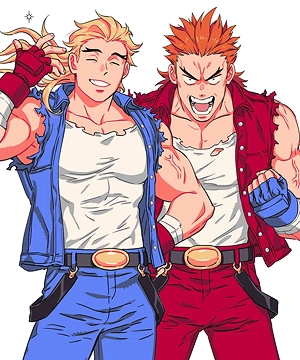
Billy & Jimmy Lee
Double Dragon
Billy and Jimmy Lee’s blue-and-red color coding turned a technical necessity into genre legend. Double Dragon was a two-player sensation that redefined beat ’em ups as we known them. Arcade operators embraced the co-op model immediately, since twice the players meant twice the quarters. The brothers themselves are differentiated almost entirely by palette, which is appropriate since the game throws endless waves of recolored thugs their way. If the enemies are going to be simple palette swaps, then why shouldn’t the heroes be too? At the end of the game, the brothers will fight for the affection of the lovely Marian. The girl will lock lips with the victor, and she’ll potentially walk past her longtime boyfriend’s corpse in order to do so! She clearly sees the brothers as being interchangeable, and that’s what this countdown is all about.
3
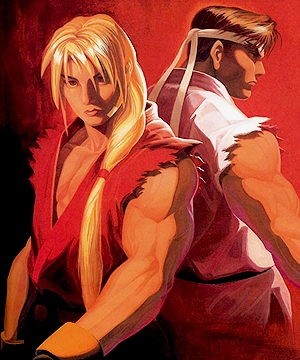
Ken & Ryu
Street Fighter
Ken and Ryu were the only playable characters in the original Street Fighter. Capcom distinguished the American fighter from his Japanese rival almost entirely by color, and they had identical stats and special moves. The game engine was highly unbalanced, but one-on-one fights were always fair since the two characters were perfectly matched. Functional differences began to emerge in subsequent games, but Ken and Ryu still stood on the same foundation. Their Shotokan fighting style became the template for several other characters, and so-called Shotoclones like Akuma, Dan, and Sakura shared the same mechanical language even though their capabilities diverged dramatically. Had Ken and Ryu not had identical movesets right out of the gate, it’s uncertain if Capcom would have used their shared style as the basis for so many others.
2
Ninjas
Mortal Kombat
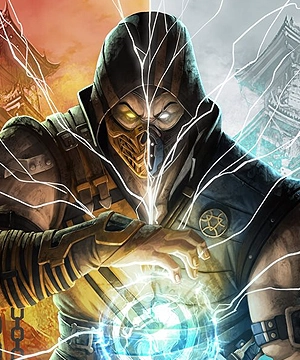
No fighting franchise leans on palette swaps more heavily than Mortal Kombat. Sub-Zero, Scorpion, and Reptile were the OGs. The blue-and-yellow ninjas shared the same digitized sprite even though they had unique special moves. Reptile blended their movesets and colors into a lethal hybrid. Smoke, Noob Saibot, Ermac, and Rain later arrived as additional palette variants. The same approach carried over to female ninjas, with Kitana, Mileena, and Jade sporting blue, pink, and green outfits respectively. Even the cybernetic era kept the trend alive through Sektor, Cyrax, and the cyborg version of Smoke. The male Chameleon and female Khameleon are the ultimate examples, since they can randomly borrow the moves and palettes of the other ninjas. What began as a simple memory-saving shortcut became a colorful cornerstone of the franchise.
1
Luigi
Mario Bros.
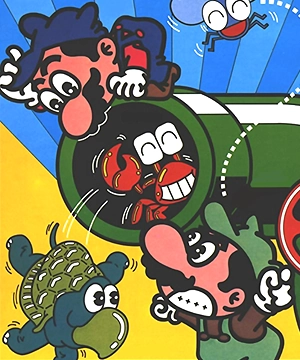
Multiplayer experiences are an integral part of Nintendo’s ongoing success, and the original Mario Bros. was their first foray into shared play. It introduced Luigi as Mario’s twin, and from that point on we were hooked on the brothers. Initially, Luigi was a pure palette swap of Mario, distinguished only by his green overalls. This identical design carried over into Super Mario Bros. in 1985. He eventually received a taller silhouette in the American Super Mario Bros. 2, but he went back to being a basic palette swap in Super Mario Bros. 3 and Super Mario World. In they years that followed, he gradually gained his own personality, voice, and starring roles. Fans still affectionately call him Green Mario as a reminder of the simple color change that launched Nintendo’s multiplayer legacy.
Published: November 9, 2026
Do you agree with this list? Let us know what you think by leaving a comment below. Your opinion matters!