
Sudden Impact
Top 10 Most Extreme Video Game Difficulty Spikes!
This list looks at gaming’s most notorious difficulty spikes. These are the moments that ambush you during otherwise chill gameplay sessions. Among other things, we’ll be discussing sudden mechanic shifts, confusing objectives, and unfair enemy swarms. From NES nightmares to modern gut-punches, the entries on this list are etched in gaming trauma. Keep in mind that we’re focusing on difficulty spikes, so games that are difficult right out of the gate are less likely to show up. Everyone knows what to expect when they start a FromSoftware game, but the entries on this list could potentially catch you off guard.
10
Hudson River Dam
Teenage Mutant Ninja Turtles
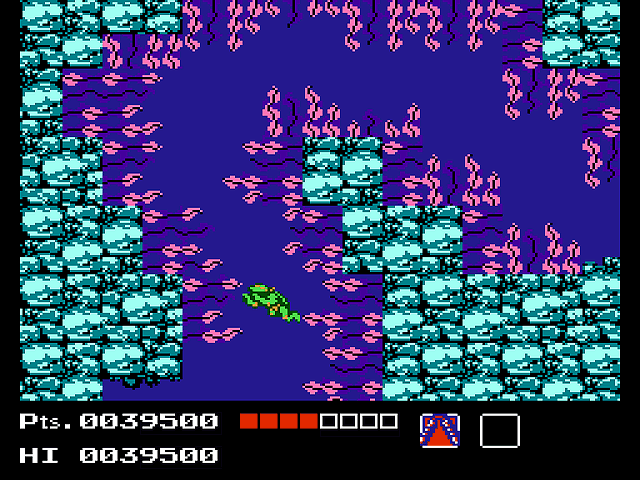
The enduring success of the Ninja Turtles franchise can largely be attributed to its appeal to young children. Likewise, the Nintendo Entertainment System was also aimed at a younger demographic. You’d figure that Teenage Mutant Ninja Turtles on the NES would be fairly easy, but it’s notoriously difficult. The first area isn’t so bad, and the ability to swap between four playable characters provides a fairly large safety net. After becoming accustomed to the game mechanics, players are thrown for a loop in the second stage. This level is like a different game altogether. The first area feels like a standard action-platformer, and players can dispatch waves of enemies using a variety of weapons. The second area is an underwater stage, because of course it is. The object here is to disarm bombs near the Hudson River dam. The swimming controls are awkward, so it can be difficult to avoid obstacles. The electric seaweed is especially problematic, and it feels like you’re threading a needle while swimming through narrow passageways. It wouldn’t be so bad if you were able to take your time, but the stage is on a timer. You have 140 seconds to locate and disarm eight bombs, and you’ll often be at the mercy of slow-moving obstacles. The game gets even more difficult in the later stages, but the dam stands out since it’s radically different from every other area. Dam level? More like damned level, amirite?
9
Down the Tubes
Earthworm Jim
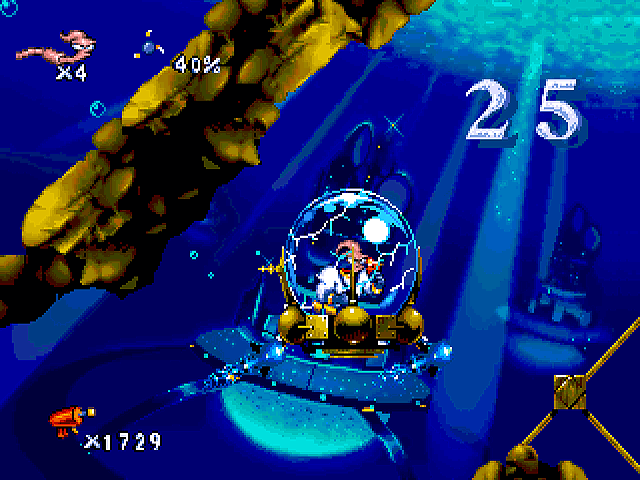
Like many of the games on this list, Earthworm Jim makes you feel like you’re playing genre roulette. Each stage introduces new mechanics, so the game always feels fresh and exciting. Jumping from one gameplay style to another isn’t always easy, but the third stage is especially jarring. Everything I said about the dam level from Ninja Turtles could be applied to the submarine sections in Earthworm Jim. The underwater segments introduce new game mechanics, they control awkwardly, and they give players a strict time limit just to make sure the experience is extra stressful. The object is to guide a submarine through rocky passageways before you run out of air. The submarine is question is a glass sphere, and the dome will start cracking when you bump into walls. You’ll feel compelled to move quickly since you’re racing the clock, but it’s hard to control your momentum and there’s no efficient way to brake. When you inadvertently hit a wall, you’ll lose precious time because your submarine will ricochet off course. It’s especially frustrating when your submarine bounces off one wall and hits another in quick succession. It doesn’t take long for the glass dome to shatter, along with the controller… and your dreams.
8
Ostrich Ride
The Lion King
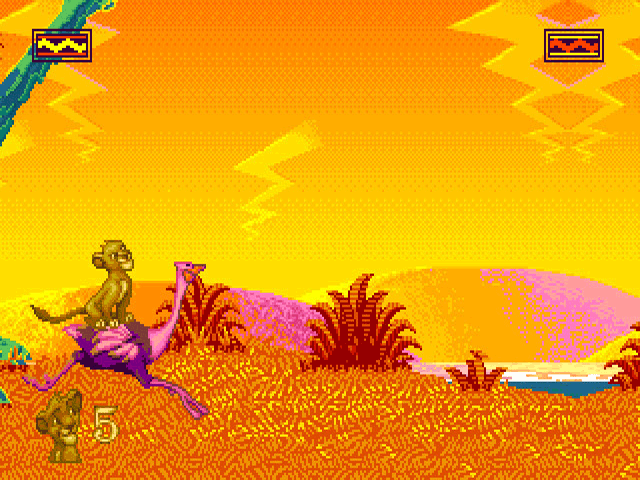
The Lion King is one of the most successful animated movies of all time, and it carries powerful messages of pain and loss. Mufasa’s death had a profound impact on younger viewers in 1994, but it wasn’t nearly as traumatic as the second stage from the video game adaptation. The first level is standard fare as far as platformers go. Assuming the role of young Simba, players jump on a few plaftorms and pounce on a few enemies before proceeding to the second level. This is where everything falls apart. Drawing inspiration from the film’s “I Just Can’t Wait to be King” musical number, the stage is overflowing with color. Nothing in the level is actively hostile, but Simba still has to navigate pasts myriads of hippos, rhinos, and giraffes in order to proceed. The tricky part comes when he has to ride an ostrich through auto-scrolling sections. The goal here is to jump over (or duck under) various obstacles. It’s simple enough on the Genesis, but the SNES version feels downright broken for a couple of reasons. It’s not always easy to differentiate between the background and foreground elements, but the bigger problem relates to the output resolutions of the respective consoles. The Genesis version runs at a higher horizontal resolution than its SNES counterpart. (The SNES version has 25% fewer pixels to work with, in fact.) This means that Genesis players can see further ahead in the level, while SNES players are given less time to react to obstacles and enemies. Some levels will make you rage quit. This one will make you run away from home, find an oasis, and live a carefree life with a warthog and a meercat.
7
Goukentou
Street Fighter Alpha 3
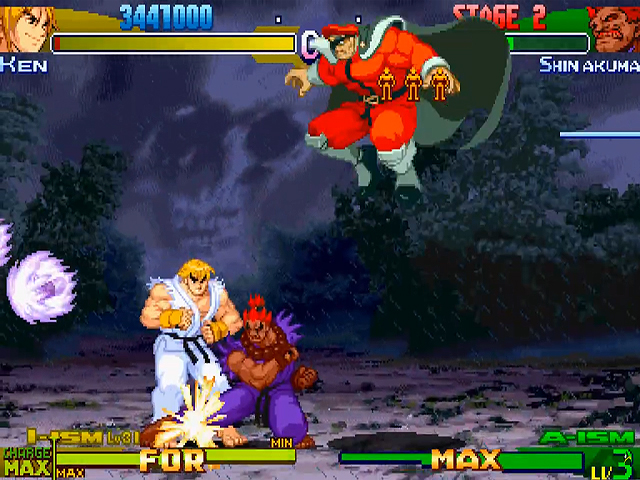
The home versions of Street Fighter Alpha 3 improved upon the arcade original in many ways. The new World Tour mode was especially noteworthy, and it’s still one of the best single-player modes in franchise history. This mode allows you to customize a character, gain experience, and learn new abilities by fighting various battles around the globe. The battles have unique rules and win conditions – some opponents will only take damage if you perform Super Combos, for example – and you’ll sometimes have to take on multiple opponents at once. The World Tour mode was introduced on the PS1, but we’re focusing on the revamped Dreamcast version. You have to be mindful of how you approach each battle, but most of the stages are fairly reasonable. The final battle is set in Goukentou, which wasn’t present in the PS1 version. Rest assured, it’s considerably harder than anything else in the game. This fight has three separate-stages, and none of them are fun. The first battle is a handicap match against Evil Ryu and Akuma. If you manage to beat them, you’ll be thrust into a survival match agaist M. Bison and Shin Akuma. In this round, the first enemy who is defeated will return to the battlefield with a full health bar. Stage 3 is a two-on-one match against a pair of super-powered M. Bisons, and it’s downright brutal. They start the round with full Super Meters, so the fight can end in a matter of seconds. If you lose a single round, you’ll have to start the entire battle all over again. If you hit a wall on the PS1, you could replay earlier stages and grind for experience like in an RPG. This wasn’t an option on the Dreamcast, so you either had to get good or restart the entire mode from the beginning in hopes of gaining more experience in your next playthrough. If you were under-leveled, you were out of luck. If you lose three times in Goukentou, you’ll have the option to give up. If you take the lifeline, the closing credits will play exactly like if you had won. It’s as though the developers knew the level was unfair.
6
Matador
Shin Megami Tensei III: Nocturne
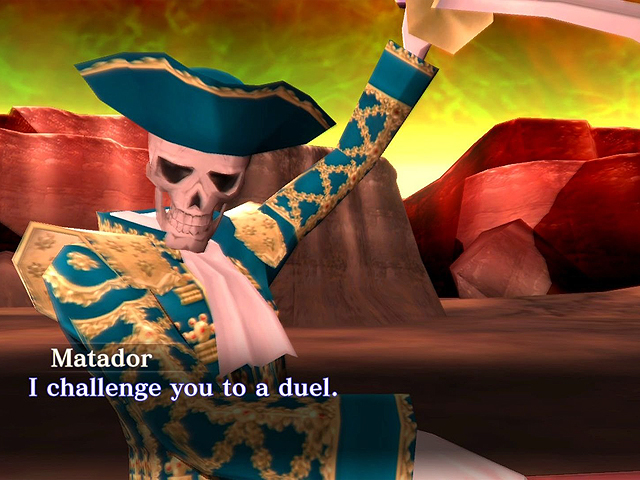
Shin Megami Tensei III: Nocturne is generally regarded as a difficult JRPG, but the game doesn’t kick into high gear until the Matador shows up about ten hours in. His notorious Red Capote skill raises his agility to an absurd degree, and it becomes nearly impossible to land a hit on him. The solution is to counter him with debuff him and lower his agility to a more reasonable level. Prior to this fight, players could usually rely on brute force alone. If that failed, they could secure victory by exploiting elemental weaknesses. The Matador forces players to take a strategic approach, and you’ll want to configure your entire team around him. He could be described as a tutorial boss, and you won’t be able to get past him without demonstrating an understanding of the game’s core mechanics. The developers went a little overboard, however, as he’s arguably the most difficult boss in the tire game. The Matador basically tells player to get good or get out, and it’s terrifying to face a boss that’s so much nastier than anything that preceded him. He’s not so bad once you figure out the puzzle, but it’s easy to see why he’s been described as a journalist filter. I maintain that the Matador is the number one reason why an easy mode was added to the HD remaster.
5
Shadow Okumura
Persona 5 Royal
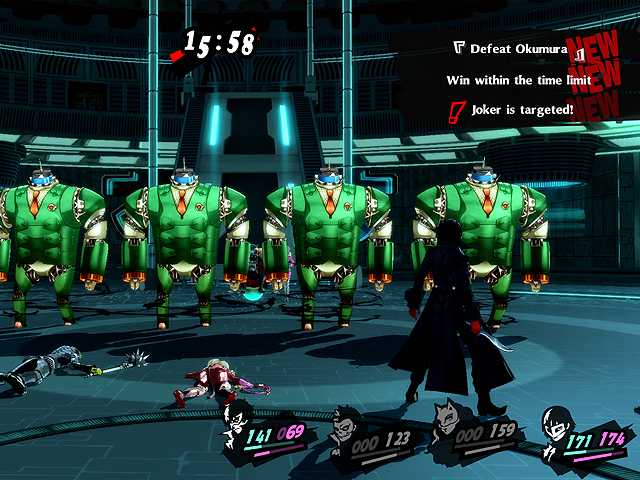
The Royal version of Persona 5 improved upon the original in many ways. In addition to numerous gameplay enhancements and quality-of-life improvements, it introduced new story content, characters, and locations. While most of these additions were welcomed with open arms, the jury’s still out on the battle with Shadow Okumura in the fifth dungeon. The game was a cakewalk up until that point, and the most difficult thing was choosing which one of the anime girls I wanted to bang. The fight with Shadow Okumura is an exercise in frustration because he’s constantly calling in minions to fight by his side. If you fail to eliminate all four of these robots within a two-turn window, he’ll simpy call in new recruits (at full health) and you’ll have to start the process over. To make matters worse, these robots are immune to most attacks, and your powerful All-Out attacks are forbidden for the duration of the battle. The battle relies heavily on the game’s Baton Pass mechanic, which most players were likely neglecting. The most aggravating thing about Shadow Okumura is that the battle has to be finished within 30 minutes. When the timer hits zero, it’s an instant Game Over. He’s the only boss in the game to have a countdown timer, and this makes an already stressful battle aggressively unfun. A single mistake can erase nearly a 30 minutes of progress! Persona 5 Royal is an all-time classic, but Shadow Okumura is a Royal pain in the ass.
4
Rugal
The King of Fighters ’94
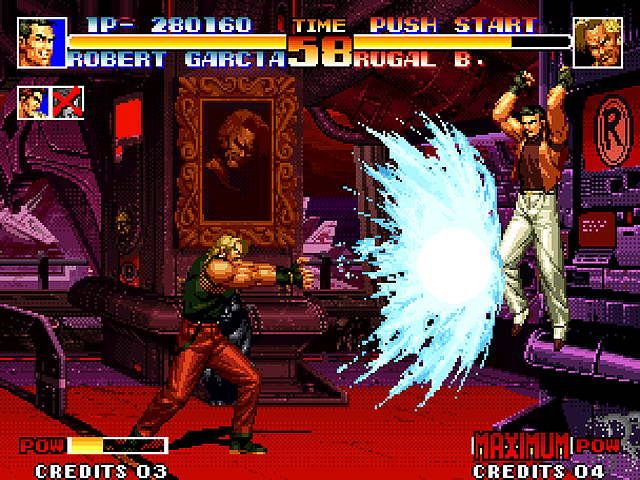
SNK fighting games frequenty feature bosses who are overpowered to an absurd degree. Geese Howard form Fatal Fury was the frist example of this trope in action. His moves had high priority, his projectile could shave off a third of your health, and his throw could be triggered against any attack. While Geese started the trend, Rugal from The King of Fighters ’94 is the poster child of SNK boss syndrome. His aptly-named Genocide Cutter is unstoppable, and it can shave off 75% of your health bar. To make matters worse, Rugal can anticipate your attacks ahead of time because the game reads your inputs. Needless to say, he’ll have no issue countering your jumping attacks. SNK games are synonymous with unfair bosses, and I could have easily mentioned Goenitz, Igniz, Magaki, or Goodman on this countdown. Even Rugal himself is given an “Omega” version in later games. For the sake of variety, I’m going to limit myself to one SNK boss. Rugal left an indelible mark in his first appearance, and he’s still a nightmare to deal with. After Rugal made his mark, SNK fans became accustomed to frustrating boss battles. As such, the difficulty spikes never felt quite as jarring. The frustration was amplified if you were playing the arcade cabinet, because each loss would cost you money.
3
Abyss
Star Wars Episode I: Racer
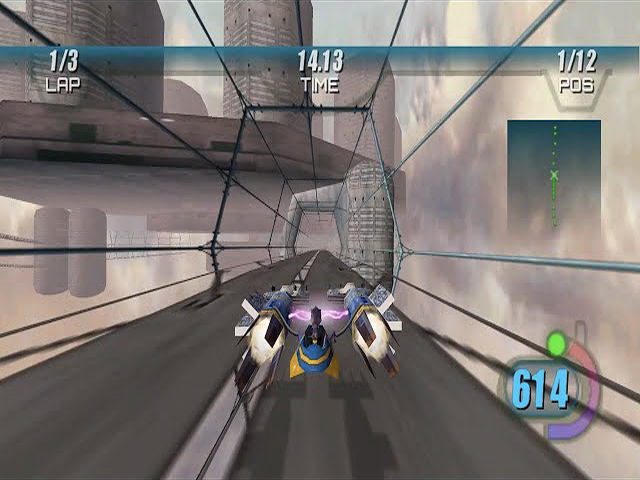
Now this is podracing! Episode I Racer is an ambitious game that deserves more credit. It has the speed F-ZERO, the secret paths of San Francisco Rush, and the maneuverability of Wave Race 64. There are dozens of tracks spanning eight diverse planets, and they are loaded with alternate routes. Abyss is the second course of the Invitational Pod-racing Circuit, and it’s the hardest track in the game by far. The track has two different layers, but only one of them matters. You’ll need to stay on top if you want to win. The bottom path forces you to take a lengthy detour around the stadium, but staying on the top path is exceedingly difficult. The track is narrow, the curves are sharp, and the guardrails are inadequate. The lower path might as well not exist, because there’s no way to recover. Losing is just a formality if you fall from the upper platform, so I’d rather just fall into a bottomless pit and call it a day. Episode I Racer is centered around speed, but Abyss will punish you for going to fast. The game encourages you to find alternate routes, but Abyss only has one route to victory. The track feels unlike every other track in the game since the winning conditions are so rigid. In every other track, you can potentially crash multiple times and still come in first place. In Abyss, one false move will seal your fate.
2
Canary Mary
Banjo-Tooie
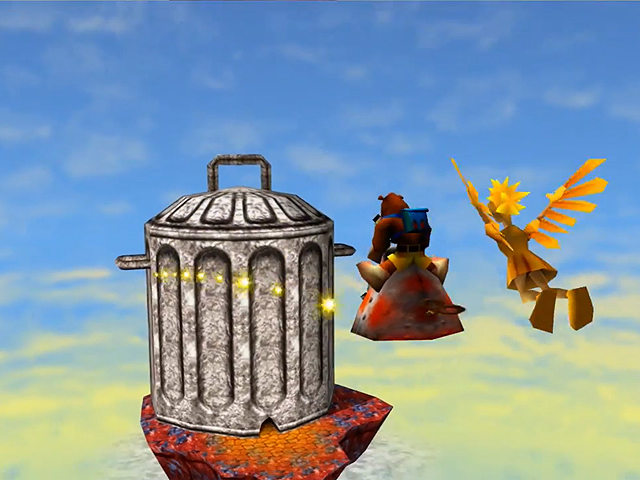
In Banjo-Tooie, players have a tremendous amount of special moves and transformations at their disposal. The challenge comes from variety, but the tasks themselves aren’t especially difficult. The final race against Canary Mary is obviously an exception, and I have nothing nice to say about the stupid bitch. Mary challenges Banjo and Kazooie to a handful of races, and offers worthwhile rewards. In order to win the races, all players have to do is rapidly press the A button on their controller. This is simple enough, until you get to the fourth (and final) race. This contest is set amongst the clouds and places our heroes on a flying clockwork mouse. It’s also complete bullshit because of aggressive rubber-banding. If you gain too much of a lead on Mary, her speed will increase artificially. After she closes the gap, her speed will almost certainly propel her to victory. The race is way longer than it needs to be, so you’ll likely run out of stamina before you can reach her. Fans have come up with all sorts of winning strategies, and most of them are exploits. Some suggest pausing the game at regular intervals in order to preserve your stamina. Others suggest rubbing the backside of a spoon over the buttons in order to hit them faster. Nintendo Power had the most practical solution, and their advice was to use a third-party auto-fire controller. The secret is to keep pace with Mary for most of the race without ever getting too far ahead (or behind). If you have luck on your side, you might be able to break out into a sprint during the final stretch before the rubber-banding kicks in. In any regard, it’s the most frustrating challenge in the game by far and the only one that I dread.
1
Turbo Tunnel
Battletoads
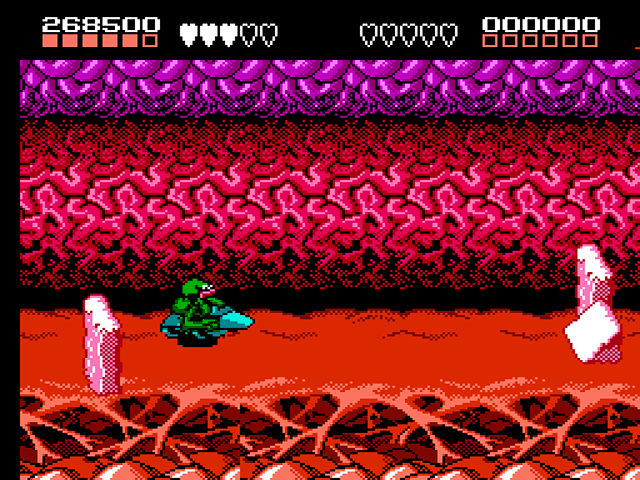
On the surface, BattletoadsDouble Dragon or the Ninja Turtles arcade games in many regards, but the second level flips the script and makes it clear that the developers aren’t afraid of mixing genres. The first two levels are relatively easy to navigate through, but all bets are off when you reach the dreaded Turbo Tunnel. In this stage, players jump on hoverbikes and are thrown into a high-speed obstacle course. You’ll have to avoid walls, dodge enemies, and jump off ramps in quick succession. There are several checkpoints along the way, and I’ll concede that it’s not even close to being to most difficult stage in the game. Nevertheless, it’s an order of magnitude more difficult than the stages that preceded it, and no level in the game caused more players to throw in the towel. Unless you have superhuman reflexes, you’ll probably crash a lot of hoverbikes before you’ll be able to progress to the next stage. Depending on your setup, the Turbo Tunnel might be even more difficult today than it was in 1991. Modern display technologies often introduce lag, and this doesn’t jive well with games that require near frame-perfect precision.


Do you agree with this list? Let us know what you think by leaving a comment below. Your opinion matters!